If you're a coffee-aholic like I am, these cartoons will brighten your day. If not, you still might like 'em! :-)
Coffee Cartoons
Tuesday, October 31, 2006


Thursday, October 19, 2006
Change of Color
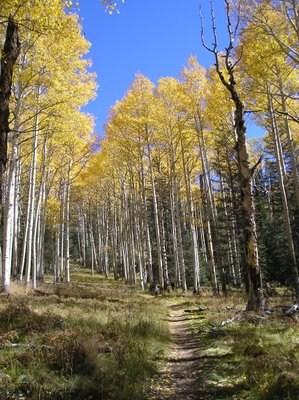
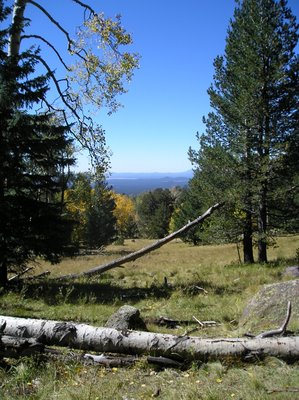
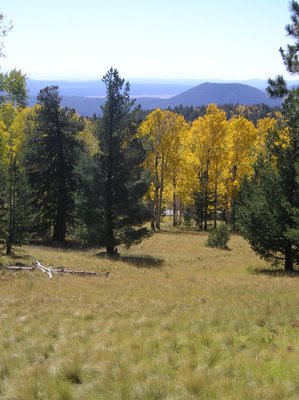
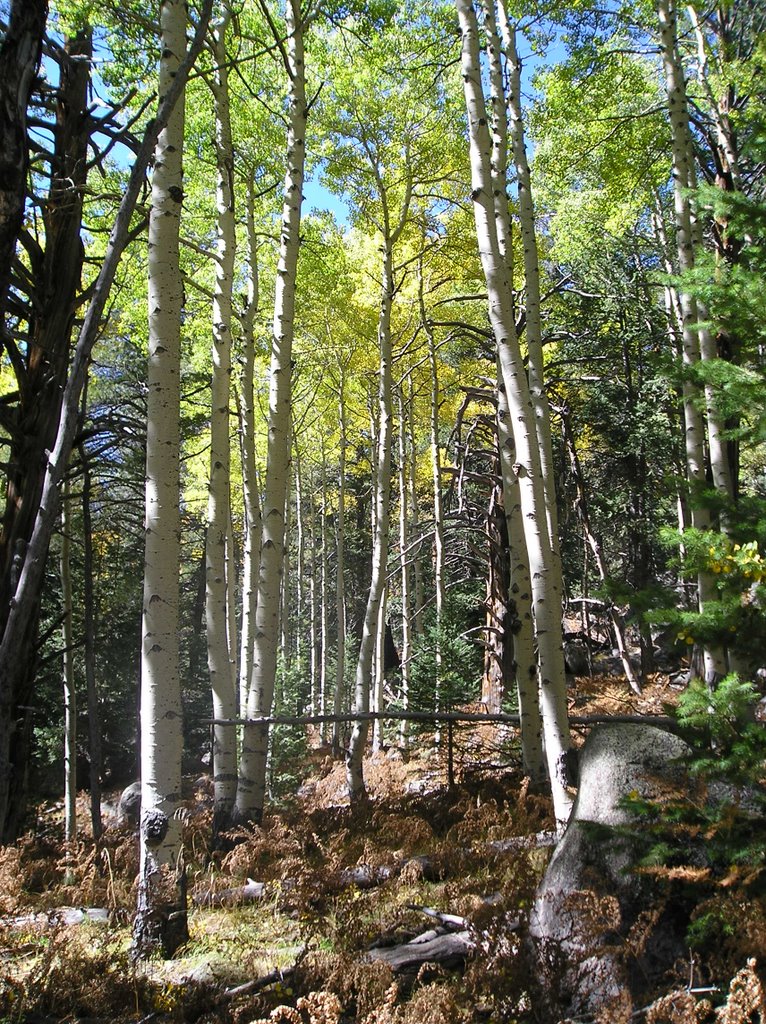
The fall colors are just about at their peak right now in Flagstaff and the city and mountain are gorgeous.
Because of our local climate (i.e. high elevation and very little precipitation), there are very few deciduous type trees that thrive here. Pondarosa pine is the most common type of tree, but the next most common is the aspen.
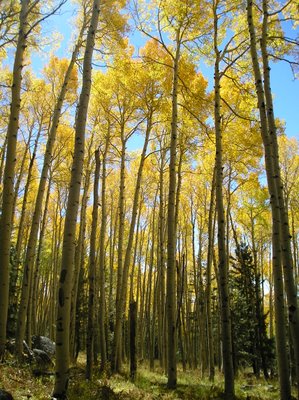
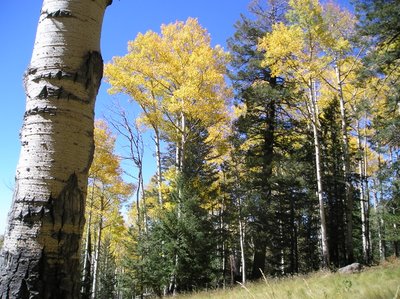
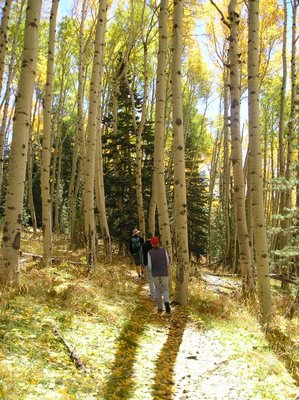
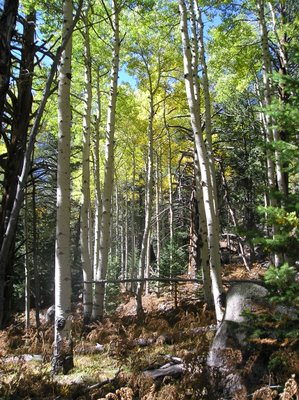
I love aspens. Not only are they very aesthetically pleasing (at least in my opinion), they also make a wonderful quaking sound when the wind rustles the leaves. Hence the name "quaking aspen", I guess. In the fall, the green leaves turn to a bright yellow color that, as the fall light filters through them, fills the forest floor with a warm, buttery light that keeps you warm even when the air is cool.
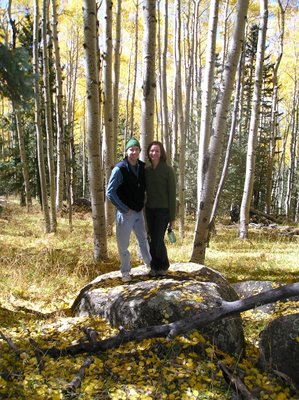
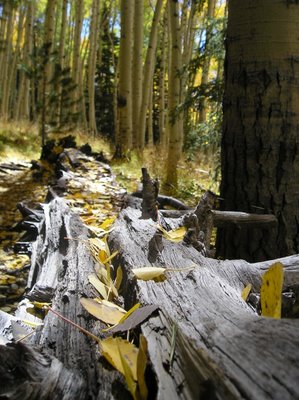
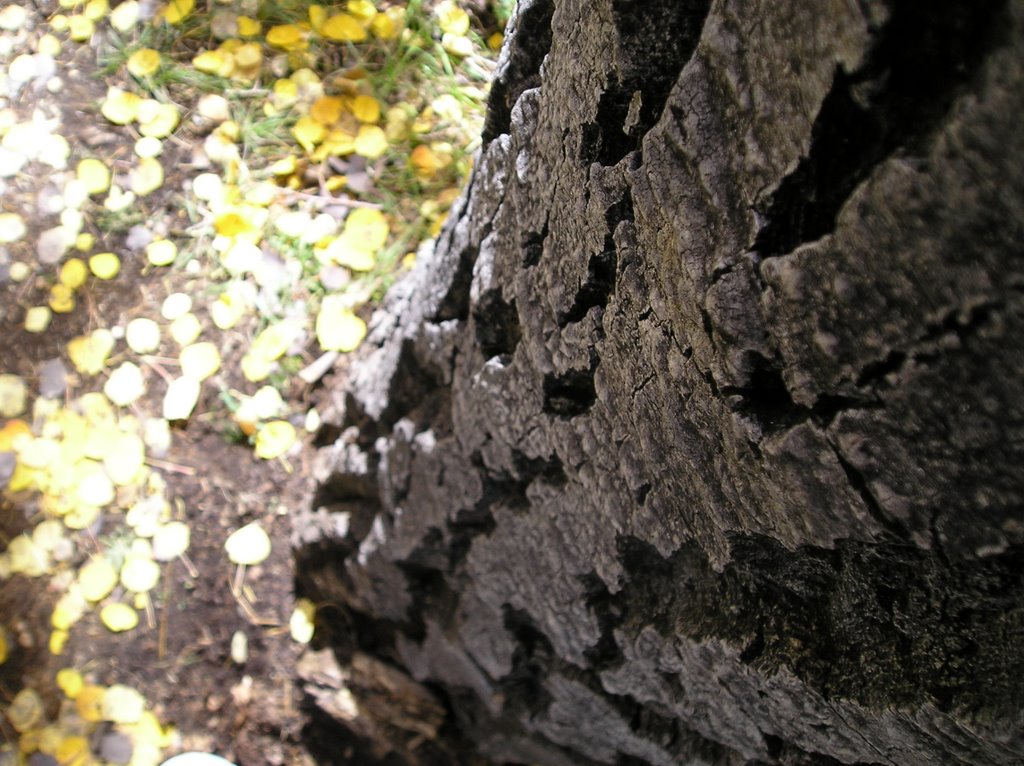
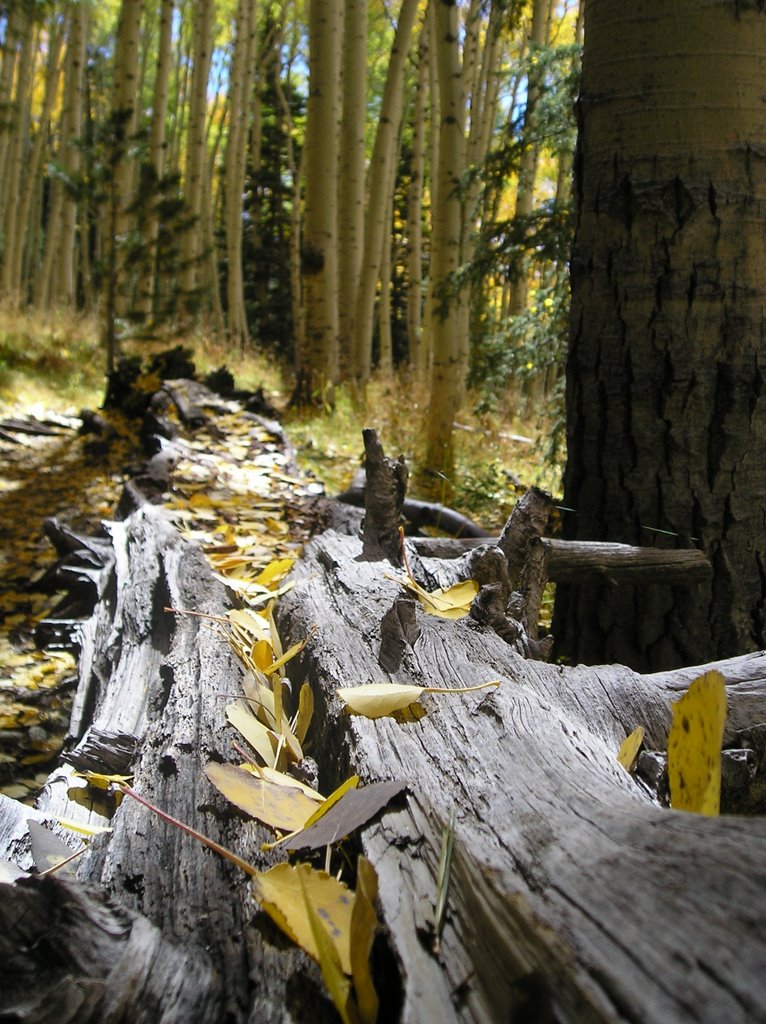
Unfortunately it won't be long until the wind and snows come, knocking the foliage to the forest floor. Luckily, we took a hike last weekend and were able to get some great pictures of the leaves. So I'll shut up now and post some pretty pictures. I hope you enjoy them.
Because of our local climate (i.e. high elevation and very little precipitation), there are very few deciduous type trees that thrive here. Pondarosa pine is the most common type of tree, but the next most common is the aspen.
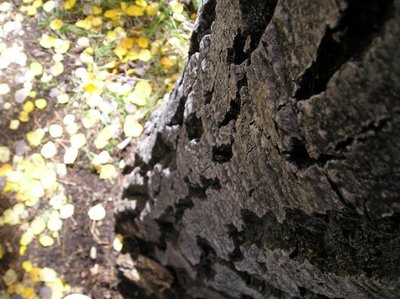
I love aspens. Not only are they very aesthetically pleasing (at least in my opinion), they also make a wonderful quaking sound when the wind rustles the leaves. Hence the name "quaking aspen", I guess. In the fall, the green leaves turn to a bright yellow color that, as the fall light filters through them, fills the forest floor with a warm, buttery light that keeps you warm even when the air is cool.
Unfortunately it won't be long until the wind and snows come, knocking the foliage to the forest floor. Luckily, we took a hike last weekend and were able to get some great pictures of the leaves. So I'll shut up now and post some pretty pictures. I hope you enjoy them.






Saturday, October 14, 2006
Wet Roads, Traumas Arrive
I saw and participated in one of my first major traumas today. It was not a very uplifting experience.
The hospital I'm at for my clinicals is pretty small and most major traumas are automatically sent to Flagstaff or Phoenix since both cities have hospitals that are rated Trauma 1. But today they sent us one for reasons unknown to me.
It was an 18 year old man who had been in an MVA. The poor kid had hydroplaned on some wet asphalt slid off the road and was ejected from the car. He had head, neck and abdominal trauma and was in pretty bad shape. They called us for a stat portable chest and pelvis x-ray and would later do a CT scan of the head and neck areas.
It was amazing to watch the docs and nurses swarm around him, all of them doing their jobs with infinite efficiency. I attempted to do my part, namely x-raying the patient's chest and pelvis, in as timely manner as possible.
Upon visual inspection it was clear the kid was in pretty bad shape and once we got the CT scan there was no denying his condition. The head trauma he had sustained had caused a massive bleed in his brain and he was more than likely brain dead already.
At this point they transfered him to Flagstaff since my hospital doesn't have a very advanced neurology dept. The news of his condition hit me harder than I would have expected. I thought about how his family's life would be forever changed by the events of that day. I did my best to continue on during the day, x-raying patients and keeping a cheery demeanor with them. But I kept thinking about when the doctor would finally have to break the news to the kid's family that he was almost certainly brain dead and would most likely not survive for many more hours. How would I react if I were given the same news about my brother, mother or wife? There is no way to know how one will react until one is put into that situation and with any luck I will never have to find out how I would respond.
The hospital I'm at for my clinicals is pretty small and most major traumas are automatically sent to Flagstaff or Phoenix since both cities have hospitals that are rated Trauma 1. But today they sent us one for reasons unknown to me.
It was an 18 year old man who had been in an MVA. The poor kid had hydroplaned on some wet asphalt slid off the road and was ejected from the car. He had head, neck and abdominal trauma and was in pretty bad shape. They called us for a stat portable chest and pelvis x-ray and would later do a CT scan of the head and neck areas.
It was amazing to watch the docs and nurses swarm around him, all of them doing their jobs with infinite efficiency. I attempted to do my part, namely x-raying the patient's chest and pelvis, in as timely manner as possible.
Upon visual inspection it was clear the kid was in pretty bad shape and once we got the CT scan there was no denying his condition. The head trauma he had sustained had caused a massive bleed in his brain and he was more than likely brain dead already.
At this point they transfered him to Flagstaff since my hospital doesn't have a very advanced neurology dept. The news of his condition hit me harder than I would have expected. I thought about how his family's life would be forever changed by the events of that day. I did my best to continue on during the day, x-raying patients and keeping a cheery demeanor with them. But I kept thinking about when the doctor would finally have to break the news to the kid's family that he was almost certainly brain dead and would most likely not survive for many more hours. How would I react if I were given the same news about my brother, mother or wife? There is no way to know how one will react until one is put into that situation and with any luck I will never have to find out how I would respond.
Friday, October 06, 2006
My First "Tipping" Experience
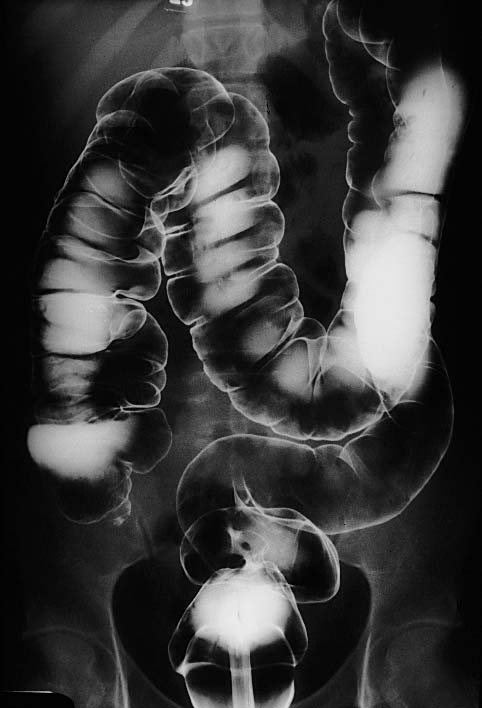
I had an interesting first experience today. One that most people will never get the opportunity to experience in their lives. I "tipped" a BE patient for the first time.
"Tipping" a patient is a nice way of saying that I inserted the tip of an enema tube into the patient's rectum and administered liquid barium sulfate into their colon. Nice huh?! I hope most of you never have to experience it.
And believe it or not the "tipping" part isn't the worst of it. In many patients the barium, and air that is added later, expands the colon and makes the patient feel like they are having horrible gas cramps. I have never had one myself, but from what the patients have been describing to me during the exam, I hope to never have to have one........or at least put off having one for many years!
BEs are often done in conjuction with or instead of a colonoscopy to look for problems in the large intestine like colon cancer, diverticula, polyps, ulcerative colitis, Crohn's disease or even appendicitis. Most of your organs are not visible on standard x-rays, so in order to visualize the colon a radiopaque material (in this case barium sulfate) is used to coat the inner lining of the large intestine and then air is injected to expand the walls so all parts of the intestine are visible on the x-ray image or under fluoro examination.
BEs are a very common exam and provide the doctors with a lot of good information about the condition of the colon.
Truthfully, I had been dreading my first experience tipping a BE patient. In school the instructors always tell horror stories about techs being pooped on by elderly patients who have not been prepped properly or of patients being unable to hold in the barium and letting loose all over the table. But so far I have not seen this and, although I am sure it happens, I don't think these problems are very common.
I guess I was most concerned with the rather intimate aspect of actually tipping the patient for the first time, but everything went well in this case. I explained to her what I was going to do and made sure she was ready before I did anything. Another tech was there to make sure I did everything correctly.
I'm actually extremely relieved that my first time is over and that it went so well. I know that they wont all go so well, but at least I can always look back and remember that my first BE tipping went smoothly.
Wednesday, October 04, 2006
Tuesday, October 03, 2006
HIV positive patient
I had my first HIV positive patient today. It was a little surreal. She didn't fit any of the stereotypes of what one might have for an HIV positive person. She was young, healthy-looking, well-spoken and polite. She seemed like your typical college-age women from anywhere in the US. She wasn't the one to tell us she was HIV positive (it was evident in her chart) and we didn't talk about it with her. All she needed done was a simple abdominal series and single view chest x-ray, so discussion of her condition was not warranted.
On a lighter note, I did my first shoulder x-ray today. Not too exciting but the pictures sure came out pretty. The shoulder is a really strange and complex joint and it's a wonder more people don't have problems with it. The patient needed both shoulders radiographed (he had been bucked off his horse a few days earlier). The tech I was with did the first one, showing me his techniques for positioning, and I positioned the patient for views of the other shoulder. Unfortunately, I couldn't comp this time because I have to do at least one exam with supervision before I can actually comp on it, but I'll be ready next time.
On a lighter note, I did my first shoulder x-ray today. Not too exciting but the pictures sure
 came out pretty. The shoulder is a really strange and complex joint and it's a wonder more people don't have problems with it. The patient needed both shoulders radiographed (he had been bucked off his horse a few days earlier). The tech I was with did the first one, showing me his techniques for positioning, and I positioned the patient for views of the other shoulder. Unfortunately, I couldn't comp this time because I have to do at least one exam with supervision before I can actually comp on it, but I'll be ready next time.
Camping trip to Lockett Meadow
Here are some pics from my wife and my camping trip to Lockett Meadow, a few miles north of Flagstaff, AZ. The meadow and hills are full of aspen and in the fall the colors are amazing. Our campsite is at about 9000 ft asl, so the nights are already pretty cold....... like 25 degrees F cold!! But we brought plenty of blankets and the fire kept us warm until we headed for the sleeping bags. It was so cool to hear the elk bugling in the distance. They kept at it for hours. My wife was sure the male was looking for a booty call! :-) Anyway, enjoy the pics.
 Our camp site
 Becky looking at the San Francisco Peaks from Lockett Meadow
 Me at a pulloff on our way to Lockett Meadow
 Becky holding an aspen leaf
 View from Lockett Meadow the morning after we camped
 Yeah...........it was frickin' cold!!!!!!
 Me contemplating the meaning of life or something just as philosophical, I'm sure ;-)
 aspen
aspen
 interesting plant
 Becky holding some aspen branches
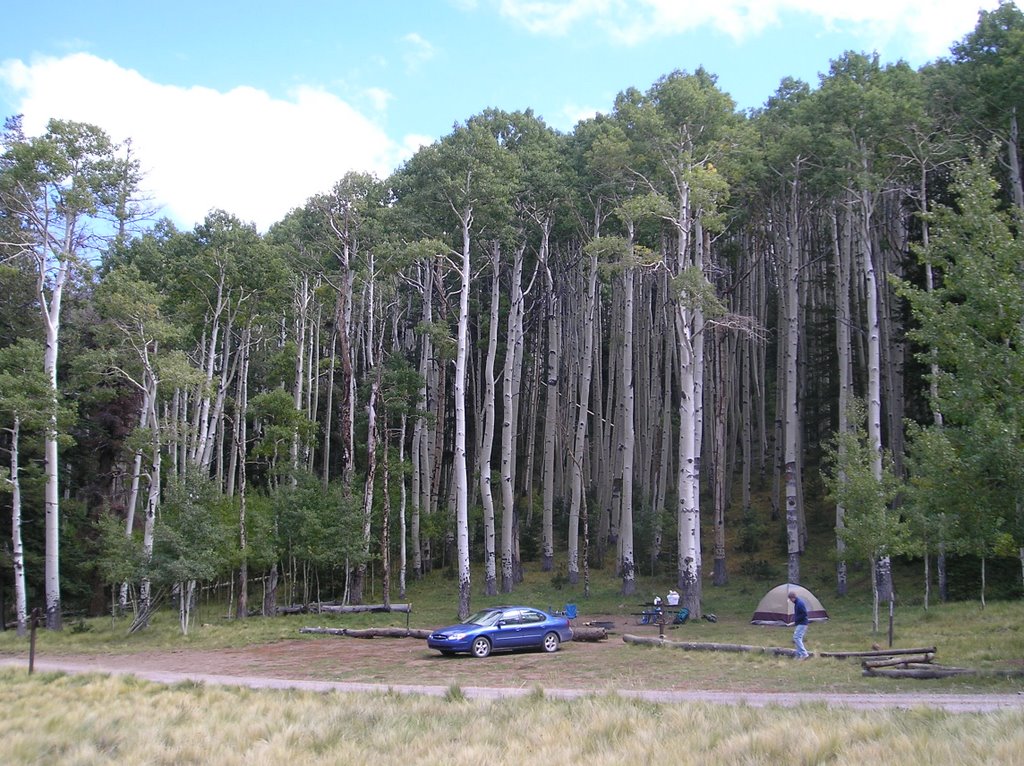 Our camp site
 Becky looking at the San Francisco Peaks from Lockett Meadow
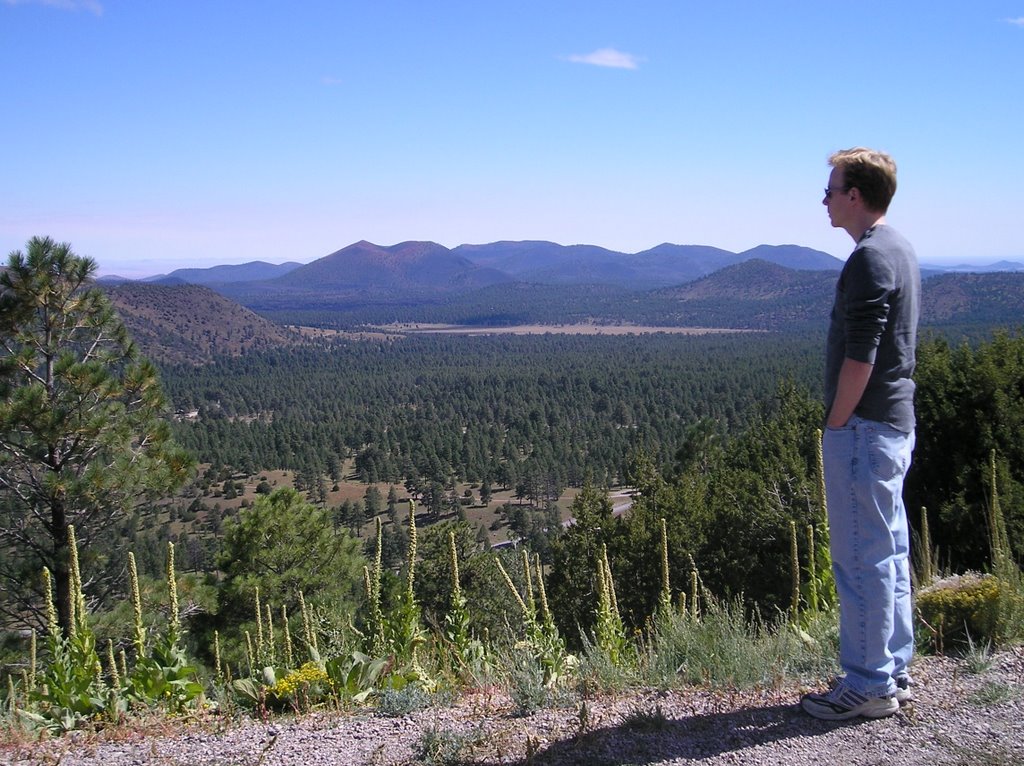 Me at a pulloff on our way to Lockett Meadow
 Becky holding an aspen leaf
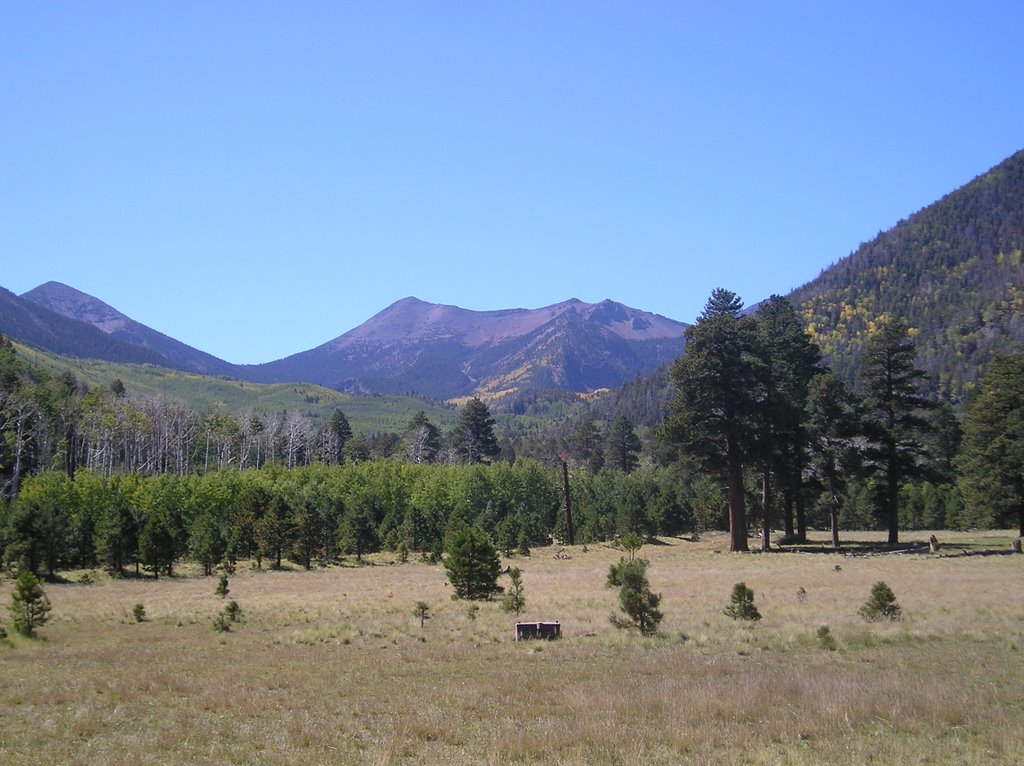 View from Lockett Meadow the morning after we camped
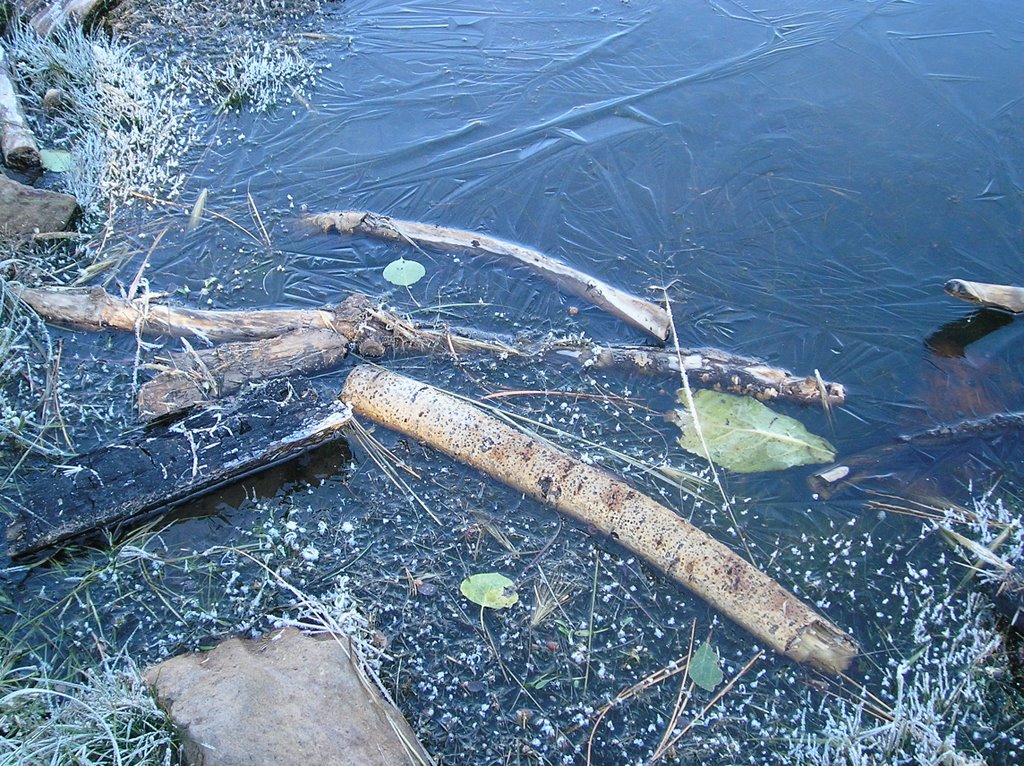 Yeah...........it was frickin' cold!!!!!!
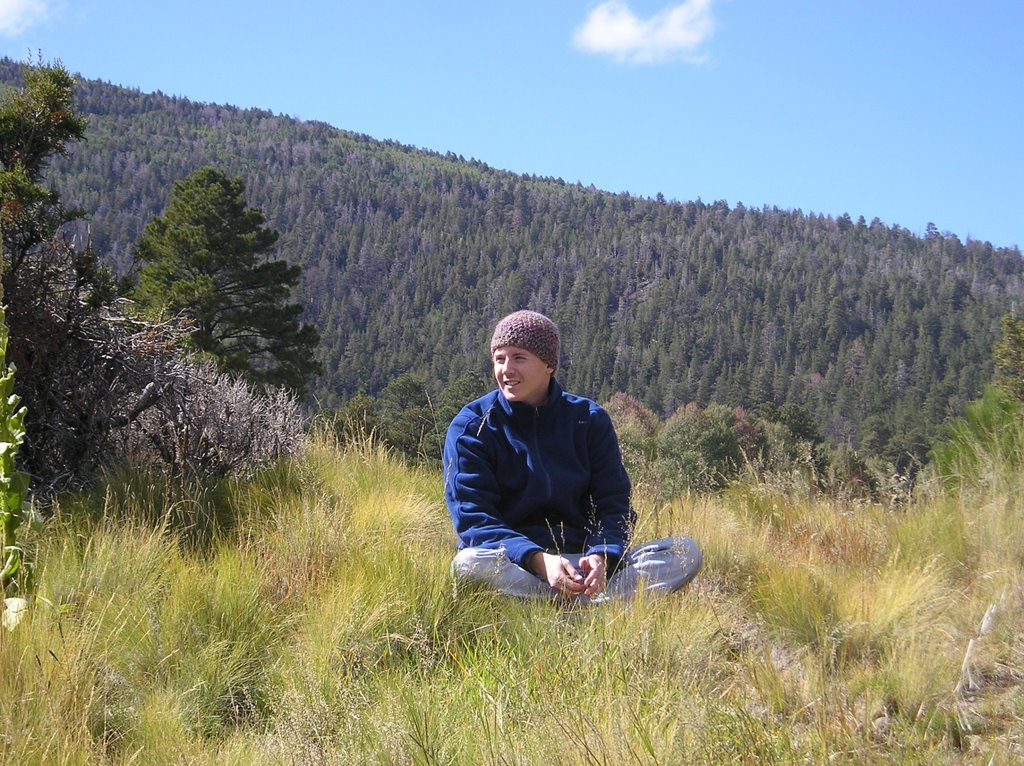 Me contemplating the meaning of life or something just as philosophical, I'm sure ;-)
 aspen
aspen interesting plant
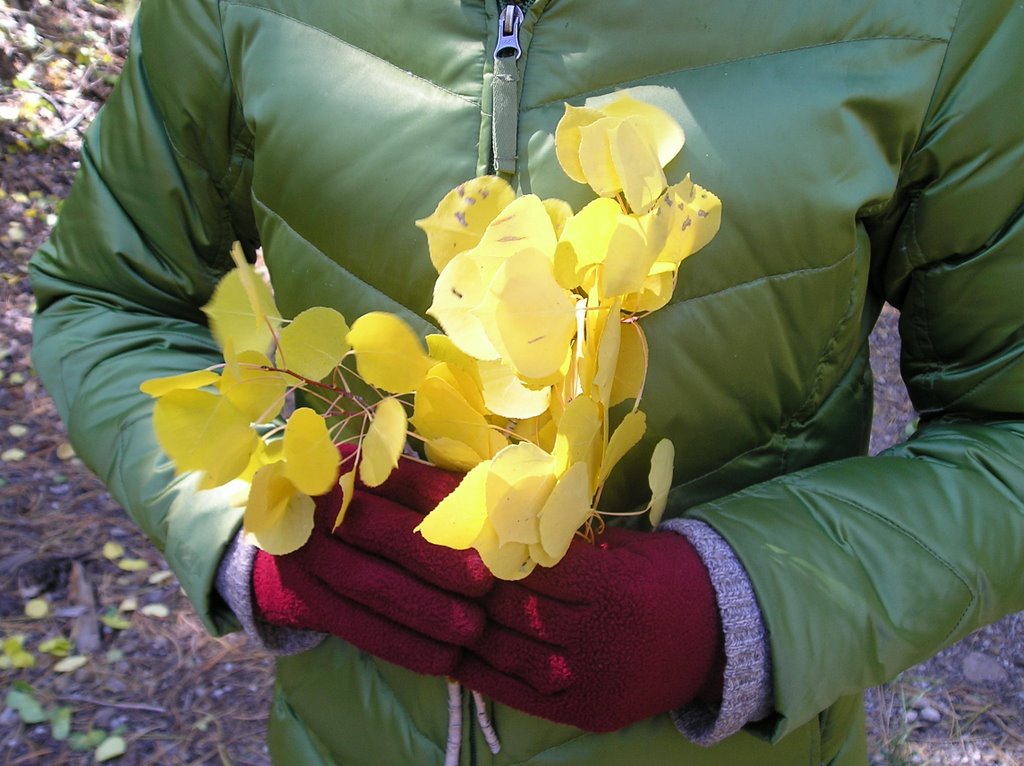 Becky holding some aspen branches
Saturday, September 30, 2006
the Good with the Bad
Working in a hospital is always interesting. You see things you would never see in other jobs. To work there, however, you must take the good with the bad. You are usually seeing people at their worst, most vulnerable point, and you have to be sensitive to that.
In the short time I've been working in the radiology department I have seen some great things, but, unfortunately, some not so great things as well.
For example, on Friday I assisted with an UGI Series on a patient who had been complaining of acid reflux and abdominal pain. During an UGI Series the patient swallows barium and we watch it pass thru their GI tract on fluoro. After we were done and the patient was changing back into their clothes, the doctor pulled me aside and showed me some of the shots he took of her stomach during the exam.
He pointed to a large, rough section of her stomach wall and explained that part of her stomach was being destroyed by cancer and could been seen on the film. Stomach cancer is one of the worst to get and metastasizes very quickly.
It was a strange and sad feeling to stand there and know that this person has cancer and probably doesn't have many more months of life left and she didn't even know it yet. Up until then I hadn't really seen too many major pathologys, just broken bones, diverticula and hiatal hernias, all of which are relatively benign compared to this patient's problem. I'm thankful that I wasn't the one to have to give her the bad news, but I'm also thankful that I was involved in diagnosing her problem, so that she may enjoy the time she has left.
Fortunately, I've also been there when patients have received good news. A couple weeks ago we had another patient in for another Upper GI series but this one also included a small bowel follow thru, where you follow the barium through the small intestine until it has reached the juncture with the large intestine.
In this patient's case, the exam was ordered because his doctor suspected the patient had a bowel obstruction, which is a simple thing in concept but can be very dangerous and life threatening for the patient. He drank the barium and we watched for over an hour (taking pics every 15 min) as it passed through his upper GI and into his small intestine. He had already had a barium enema a few days before so the doc knew that his large intestine was not blocked, so if he was obstructed it would have to be in the small intestine.
But as we watched the barium progress through his system it was clear that there was no obstruction, which meant he would not have to have emergency surgery as the doctor suspected. I still remember the look on his face as the doctor told him the news that he wouldn't have to have surgery. He was so happy and relieved I couldn't help but smile and congradulate him on the good news. It was a good moment for me and I felt lucky I could be there for it.
In the short time I've been working in the radiology department I have seen some great things, but, unfortunately, some not so great things as well.
For example, on Friday I assisted with an UGI Series on a patient who had been complaining of acid reflux and abdominal pain. During an UGI Series the patient swallows barium and we watch it pass thru their GI tract on fluoro. After we were done and the patient was changing back into their clothes, the doctor pulled me aside and showed me some of the shots he took of her stomach during the exam.
He pointed to a large, rough section of her stomach wall and explained that part of her stomach was being destroyed by cancer and could been seen on the film. Stomach cancer is one of the worst to get and metastasizes very quickly.
It was a strange and sad feeling to stand there and know that this person has cancer and probably doesn't have many more months of life left and she didn't even know it yet. Up until then I hadn't really seen too many major pathologys, just broken bones, diverticula and hiatal hernias, all of which are relatively benign compared to this patient's problem. I'm thankful that I wasn't the one to have to give her the bad news, but I'm also thankful that I was involved in diagnosing her problem, so that she may enjoy the time she has left.
Fortunately, I've also been there when patients have received good news. A couple weeks ago we had another patient in for another Upper GI series but this one also included a small bowel follow thru, where you follow the barium through the small intestine until it has reached the juncture with the large intestine.
In this patient's case, the exam was ordered because his doctor suspected the patient had a bowel obstruction, which is a simple thing in concept but can be very dangerous and life threatening for the patient. He drank the barium and we watched for over an hour (taking pics every 15 min) as it passed through his upper GI and into his small intestine. He had already had a barium enema a few days before so the doc knew that his large intestine was not blocked, so if he was obstructed it would have to be in the small intestine.
But as we watched the barium progress through his system it was clear that there was no obstruction, which meant he would not have to have emergency surgery as the doctor suspected. I still remember the look on his face as the doctor told him the news that he wouldn't have to have surgery. He was so happy and relieved I couldn't help but smile and congradulate him on the good news. It was a good moment for me and I felt lucky I could be there for it.
Wednesday, September 27, 2006
List of Stupids
Below is but a short list of things patients have done to land them in our x-ray department.
- drive an ATV drunk......and at night.
- drop a box of frozen french fries on their foot
- jump off a swing
- tried to do a "wicked cool" trick on their skateboard
- slammed their elbow in the refridgerator door
- got out of a car wearing very high heels and turned their ankle
- got a bowel obstruction (OK, so this one isnt so funny)
- wiped out pulling a wheelie on their motorcycle
- hit a light pole while driving drunk (but decided not to come in for two days!!)
- got bumped in their recently operated on elbow by a waitress
- got pneumonia (Again, not so funny)
And my all time favorite...
- they put their leg down in an attempt to stop an 800 lb. ATV going 20 mph instead of using the break.
You would think that the last one would be an isolated incident, but unfortunately it is not. It happens all the time with ATV and motorcycle riders.
So do your best to avoid doing any of the above activities because I'd rather not see YOU at the other end of my x-ray machine any time soon.
- drive an ATV drunk......and at night.
- drop a box of frozen french fries on their foot
- jump off a swing
- tried to do a "wicked cool" trick on their skateboard
- slammed their elbow in the refridgerator door
- got out of a car wearing very high heels and turned their ankle
- got a bowel obstruction (OK, so this one isnt so funny)
- wiped out pulling a wheelie on their motorcycle
- hit a light pole while driving drunk (but decided not to come in for two days!!)
- got bumped in their recently operated on elbow by a waitress
- got pneumonia (Again, not so funny)
And my all time favorite...
- they put their leg down in an attempt to stop an 800 lb. ATV going 20 mph instead of using the break.
You would think that the last one would be an isolated incident, but unfortunately it is not. It happens all the time with ATV and motorcycle riders.
So do your best to avoid doing any of the above activities because I'd rather not see YOU at the other end of my x-ray machine any time soon.
Friday, September 22, 2006
Apologies
 I apologize for the lack of postings the last few weeks. The truth is I'm still pretty exhausted when I get home from clinicals at the end of the day and find it hard to form a complete, coherent thought much less attempt to compose a witty and entertaining post. Not that I have ever been successful at that in the past! :-P
 Unfortunately, I no longer have the big, healthy doses of spare time I used to have while I was living in Phoenix and only going to classes. I now have to use what little free time I have for doing housework, running errands, spending time with my wife and the all important job of entertaining the cat.
I know, excuses, excuses, excuses. I don't mean to justify my relative absence to the blogosphere, but there are some good reasons I have not been around. I hope my loyal readers will not lose faith in me and go off in search of greener and more frequently updated pastures, and I hope my new readers, especially those of the rad tech student persuasion (you know who you are) will continue to check my site for my not-so-witty, not-so-entertaining updates. ;-)
And now, as I see the spaghetti water is finally boiling, I must bid you all a fond adieu. Enjoy the weekend and please do check back from time-to-time for updates on the life and times of X-ray Tech Student (Formerly) in Phoenix.
Tuesday, September 12, 2006
Poor Little Guy
 "Oowwww!!! Why are you hurting me!!?!?" he screamed in my face. "I'm sorry 'Jimmy'*, I know it hurts. Just be as brave as you can and we'll be done soon, OK?" I replied.
'Jimmy', the poor little guy, had fallen off a swing at the park and broken his wrist. How did I know it was broken? Well, it looked something like this. So, although I'm no doctor, it was pretty safe to say it was broken.

His parents brought him into the ED about 30 minutes earlier and the doc had ordered a stat 2 view order for his wrist, and with good reason. So I and another tech hurried to the ED to take the x-rays, develope them and get them back to the doc as soon as we could. 'Jimmy's' parents and the other tech positioned his arm, while I got the portable x-ray unit in position. We needed a PA and Lateral view of the wrist, so poor 'Jimmy' had to endure the pain as we switched cassettes in between x-rays.
Being seven isn't easy, but being seven with a severaly broken wrist really isn't easy. But he was brave and put up with our manipulation of his injuried limb with much less protest than I would have thought.
Once back in the rad dept, we developed the images and took a look at them to make sure the density and contrast was right and all pertinent body parts were in view. From looking at the image it was apparent that 'Jimmy" had sustained some major trauma to his wrist. He had broken his distal ulna and radius just below the head, and the bones had displaced and were no longer in line, hence the gruesome look of his arm.

It was a difficult situation. You're torn between getting a quality image that will give the doctor all the information he needs about the injury, but at the same time you absolutely don't want to cause any more pain to the pt, in this case a child, than is necessary. Overall, the tech did a great job comforting the pt and his parents who were visibly upset. I just hope that with time and "practice" I will be competent enough to do as good a job as this tech did.
*all names have been changed to protect patient privacy.
Saturday, September 09, 2006
Battlefield Radiography
The above is a video produced during the 1940s about a new technology used to treat wounded soldiers on the battlefield. It seems to be similar to a mobile fluoro unit or C-arm that is used today in surgery.
Notice that neither the patient nor the doctors have shielding of any kind and are probably receiving very high doses of radiation. Oh how times have changed.
The above is a video produced during the 1940s about a new technology used to treat wounded soldiers on the battlefield. It seems to be similar to a mobile fluoro unit or C-arm that is used today in surgery.
Notice that neither the patient nor the doctors have shielding of any kind and are probably receiving very high doses of radiation. Oh how times have changed.
Thursday, September 07, 2006
Surgery
 Today I had my first experience in surgery.
I wasn't in the door two seconds and L grabbed me and we were on our way to assist in surgery. The docs were doing a hip pinning and needed fluoro guidance.
We made our way up to the OR and went into the surgical prep room. L handed me a long white, paper suit, and told me to put it on. "We always have to wear the bunny suit in surgery" she tells me. "Ha ha" I thought, "lets make fun of the newbie student and dress him up all stupid-like." But as I watched she pulled one out for herself and started putting it on. "OK, fine" I thought "I'll put it on if she has one too. How stupid could I look, right?" Well, as it turns out pretty stupid, but at least I wasn't only one.

After that we made our way to OR Room 3 where the docs had already prepped the pt for a hip pinning. This is where they insert a few metal pins, although bolts is more accurate, into a bone to reinforce it. They needed us, or rather L, to run the fluoro machine so they could correctly position the pins in the pt's hip.
The mobile fluoro machine, more commonly called a C-arm, is a type of x-ray machine that creates real-time images. Instead of producing x-ray "snapshots" like a regular x-ray machine, it uses x-rays and a special sensor to send a live, moving picture of the patient's bones and/or organs to a TV screen. This allows the doc to see precisely where he or she has positioned the pins.

It was very interesting and I'm looking forward to getting back in there again soon. It's a bit intimidating, however, and I am already dreading the day I screw something up and get chewed out by the surgeon, but I think it will also be an amazing experience.
Wednesday, September 06, 2006
First Two Weeks
 Wow, folks. I really apologize for the relative scarcity of posts lately. Not that there are thousands out there hanging on my every word, but I know some people like to check out this blog on a somewhat regular basis and I hope I don't lose those readers. You know who you are! ;-)
 Anyway, the past two weeks have been my first two weeks of clinicals in radiography. For those of you who have done clinicals, you know the first few weeks are the most challenging. Everything is new to you, there are about a million things to learn and more is expected of you than you think can be done in a lifetime. But so far I'm surviving and keeping my head above water, well most of it anyway. My chin and mouth sink below the waves from time to time.
At this hospital the Out-patient radiology dept is separate from the in-patient radiology dept. In fact they are on opposite sides of the hospital from each other. I spent my first week in the out-patient dept and was paired up with another rad tech. Let's call her L, for anonymity's sake. The out-patient dept is relatively slow I came to find out, although it didn't seem that way to me at first. In out-patient we do rather routine examinations like chest x-rays and x-rays of the spine, extremities and ribs, as well as mammography and DEXA scans (bone density scans). These are exams that are not emergent, don't require complex equipment or doctors and very little, if any, prep is needed on the part of the patient.
I was able to observe and take part in several exams. My first couple were for the L-spine, the pelvis and hip, the wrist and the foot and lots and lots and lots of chest x-rays. Chest x-rays are so common, in fact, that they have a room entirely dedicated to doing just chest x-rays. Chest x-rays are ordered for anything from shortness of breath (SOB) to pneumonia to suspected fluid in the lung. Luckily this is a fairly simple exam and I have already done several myself, with tech supervision of course. I suspect that a routine chest x-ray will be the first exam I "comp" on. (comp = competency, doing the entire exam successfully myself with no corrections from the supervising tech).
This week was different however, in that I wound up in the in-patient dept.
 Which means a whole new batch of procedures and exams to learn, and learn quickly. Luckily they partnered me up with L again (most of the time) and she is a fantastic teacher. She has only been a tech for 3 years, which helps because she remembers how overwhelming everything can be at first and how much there is to learn and how little time there is to learn it.
In the in-patient dept they take care of all the other imaging exams that the out-patient dept doesnt. This includes all exams ordered for pts (patients) in the ED (Emergency Dept), those staying in the hospital, the maternity ward, and the OR. They do procedures that require fluoroscopy and the portable x-ray unit, and procedures that are more "invasive" like BEs, UGIs, esophograms and IVPs. Nuclear medicine, CT, MR and ultrasound are also assocated with this dept, however, specially trained techs do those procedures.
I'm finding out that it's all a very complex operation and there are about a million little details to get right for everything to turn out correctly. I have seen and learned a lot in the 2 short weeks I've been at clinicals, but I still have a long road ahead of me. I hope I can make it. Wish me luck.
Subscribe to:
Posts (Atom)